Giovanni Baldelli
an anti-fascist interned as a fascist
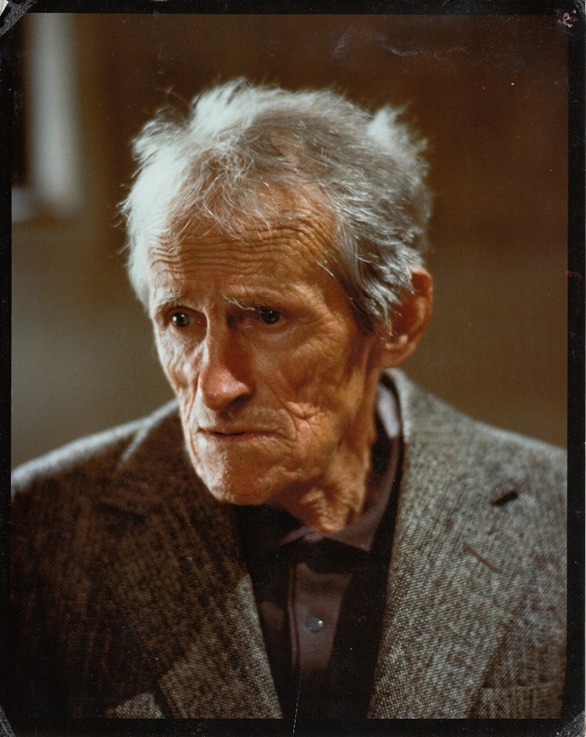
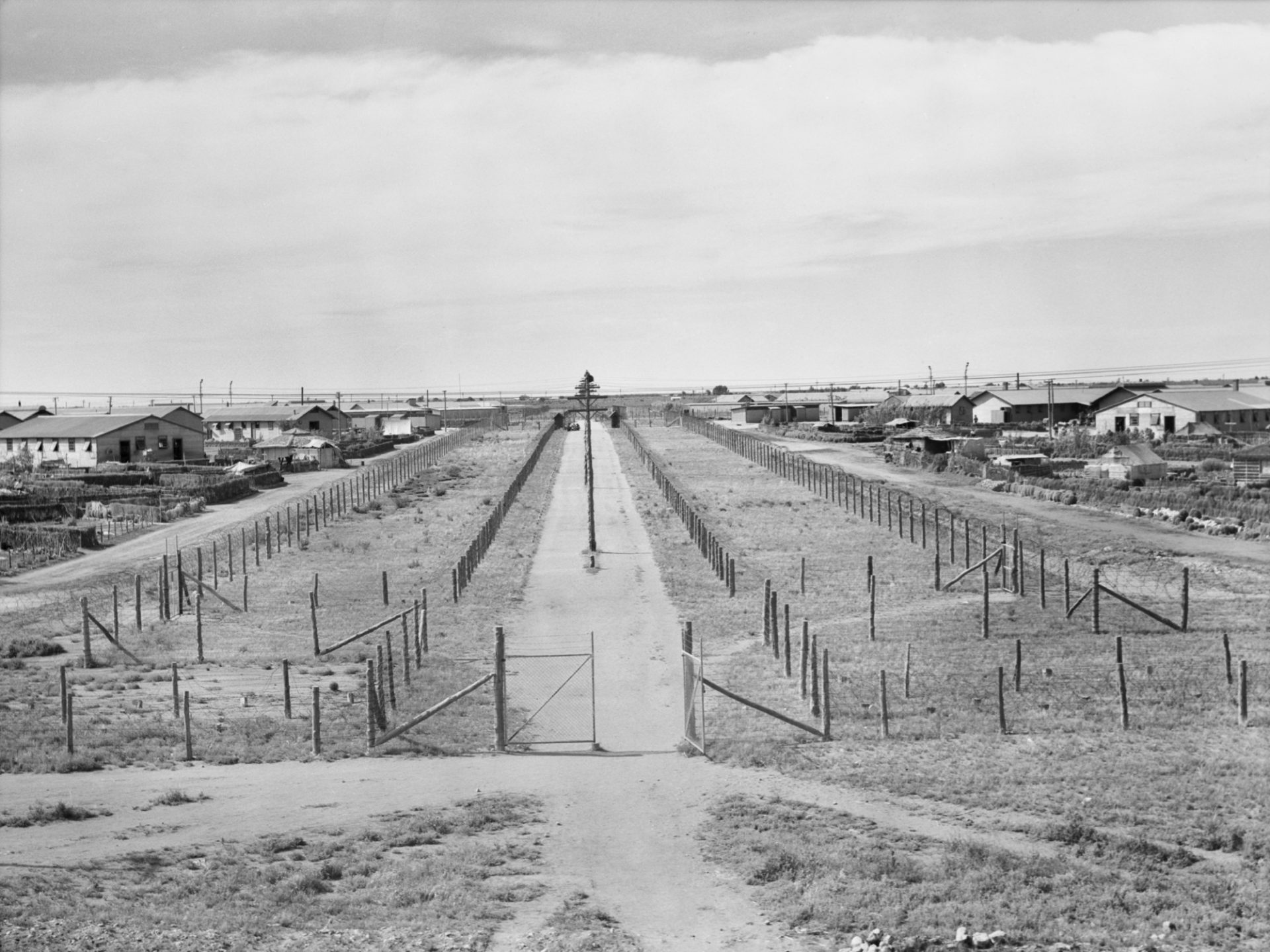
A ‘Dunera Italian’, Giovanni Baldelli’s situation was a conundrum. Although Baldelli claims anti-fascist views, this seems strange in view of his father’s high position in Fascist Italy[1] so reported Commandant, No. 2 Internment Camp Tatura to Major Julian Layton on 26 August 1943. Baldelli’s father, Major Luigi Baldelli, was an Italian Censor in Bolgona, Italy, but although serving within the Italian Fascist Government had always supported his son’s political views.
Baldelli’s interest in politics began at a young age. Journalist Alfio Bernabei explained that Baldelli …was only fifteen when under the influence of a few drinks, as he put it, he began to sing Bandiera Rossa at a wedding reception. Bandiera Rossa or Red Flag was the Communist hymn. On hearing that he might be arrested as an antifascist his father, a hotel manager near Bellagio, speedily arranged for his departure to France where the Baldellis had relatives.[2]
He returned to Italy, and at 18 years old, on 19 March 1933 was arrested in Milan along with other members of Giustizia e Liberta and imprisoned in Rome’s Regina Coelia which was well known as the anti-fascist, fascist traitors and partisans prison. Bernabei explained that Baldelli, undertook to return to Italy and distribute antifascist leaflets, including some in the Duomo in Milan, for which he was arrested and had to spend nine months in prison, five of which in total isolation. He suspected that he had been set up by a fascist secret agent. Once out of prison his father, whom he described as a fascist “only because of interest”, managed to get him a new passport and this time Baldelli chose to go to England.[3] It was at this time that he began writing under a pseudonym for Solidarite Internationale Antifasciste and served on several committees to help Republican Spain.
Despite his commitment against fascism, on 13 June 1940, schoolmaster Giovanni Baldelli was arrested in England as a ‘fascist.’
Of his arrest Baldelli reflected, “Such was the fate of a proven anti-fascist in the so called war against Fascism!”[4]
Survivor of the sinking of the Arandora Star in the Irish Sea on 2 July 1940, Baldelli, along with 199 other British Italian internees, was then boarded on the Dunera on 10 July 1940 and arrived at Tatura Camp 2, Victoria on 3 September 1940.
During internment in Australia he dedicated most of his spare time for the community. Baldelli gave lessons in French, English, Spanish and Italian and there is mention of him giving a lecture on Christianity. He established a theatre community and he kept busy writing plays, ensuring their staging, costuming and reserving for himself, often, the female role which others were reluctant to play.
In 1985, Giovanni Baldelli worked with Alfio Bernabei on the documentary Dangerous Characters, The Arandora Star Tragedy and shared his memories of camp performances. Bernabei wrote, The title of one of his plays was ‘June 10’ and dramatized the arrests of Italians in Britain. Another was called ‘Canzone dei 200’ and it was for this one that he wrote the words for the tune. “I don’t remember if the song was at the beginning or at the end of the play” Baldelli told me, “but I remember that in the audience there was a fascistone who on hearing the tune exclaimed “but this is Caserio’s aria!” Sante Caserio was an anarchist who made an attempt on the life of the president of the French Republic Sadi Carnot.” The song was performed by an internee who had a very good voice, Baldelli remembered, and the “special effects” were done quite professionally because among the internees there was “a certain Montagna who used to work for Gaumont.” [5]
Canzone dei 200 is an elegiac song eloquently narrating the tragedy of the Arandora Star as it unfolded. The second part of the song reflects on the Dunera voyage and arrival in Tatura.
Canzone dei 200 (Translation by Wilma Stark)[6]
Early that July morning
Before e’en the break of day
On still dark waves swiftly onwards
She silently stole us away
Away from the firesides
All we Italian men
Heading for who know where
Torn from our kith and kin.
Each man was cold and trembling
Unable to understand
As the ‘Arandora’ sped onwards
Toward some far off land
Then an almighty explosion
Suddenly blew us away
Sounding the knell for many
On that cold and terrible day.
Up top and down below
Each man, ‘alien’ or ‘friend’
With stricken hearts and trembling limbs
Knew the ‘Star’ was near her end.
The lifeboats were lowered
Too few for so many men
The Captain’s words to all
‘Save yourselves – all who can’
Down, down she went to the bottom
Our brothers down, down to the deep
Some praying, some cursing the Gods above
All bound for a cold, cold sleep
And we still above on the water
Tears falling down on the waves
And the bodies of our Brothers
Whom no-one now could save.
We prayed to the Good Lord above us
Each man, friend or foe
And out of the skies came an angel
A reward for our Faith there below.
Gathered up by the warm hands
Of Torpedo-Boat H83
An act of Brotherhood
Snatched us from the sea.
(Dedicated to all who died, and survived. Including Family and friends left behind, and those transported in the ‘Ettrick’, to Canada)
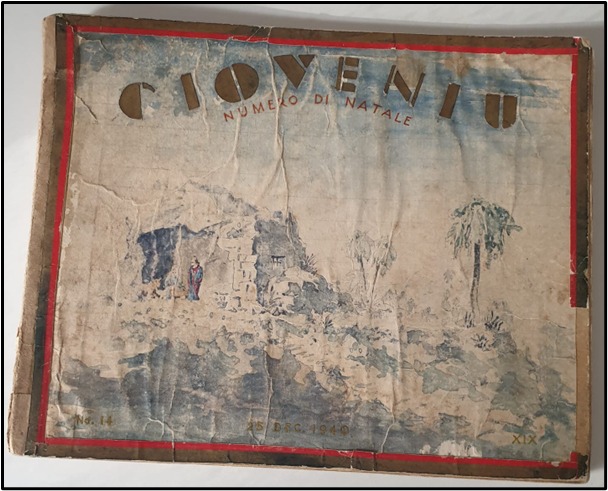
Another of his projects was the camp newspaper. Within two weeks of the group’s arrival in Australia, Baldelli had suggested a ‘camp paper’ and a committee of six was formed from the younger internees to write and publish Gioventù. Giorgio Scola, a student of architecture, was a committee member who wrote in his diary: Monday 23 September
At the Assembly, our Camp Leader commends the Youth of the Camp for its initiative in producing a camp paper and hands back the first copy of "Gioventù" duly passed by the Military Authorities. The editorial staff including myself are quite elated to find that our paper is in great demand within the camp.[7]
The only known surviving copy of Gioventù is Issue No. 14 25 December 1940. This Christmas Edition was beautifully decorated with articles written in Italian and English on a range of subjects: L’Industria delle Paste Alimentari (GVL), Un Brutto Natale (G. Cocozza), La Riviere (E Bianchi), Christmas Wedding (L Beschizza), Due Natali (P Beshizza), Sports News (PV Tolaini), and Port of Call (G Scola).
Outside of these more cultural pursuits, Giovanni was involved with sports playing football, and in the wood cutting and farm parties. On 16 May 1944, Giovanni was ‘released on parole’ becoming a wood cutter in the Victorian bush working for the Forestry Commission. Baldelli would write to his friend Dino Accini about the freedoms of being outside the barbed wire. He wrote, The other day I was taken by car to Wangaratta where they were holding a discussion in English on the Italian people and their conditions under the fascist regime. There were not many people there, but they were well chosen and intelligent. One of the listeners invited me to dinner at his home the next day together with Pietro Beschizza. There we found ourselves for the first time in a warm family atmosphere engendered by the kindness and charming simplicity of the wife and by the Italian music…[9]
On return to England in August 1945, Baldelli returned to teaching and then completed his B.A. Honours at the University of London in 1948. Outside of his teaching career, he involved himself in literary and political pursuits. He became involved with the social anarchist movement by writing articles during the 1950s and 1960s for Freedom: Anarchist Monthly. He was also actively involved in the Anarchist Commission for International Relations and from 1968 onwards, he wrote regular articles for the Italian Anarchist Journal L’Internazionale.
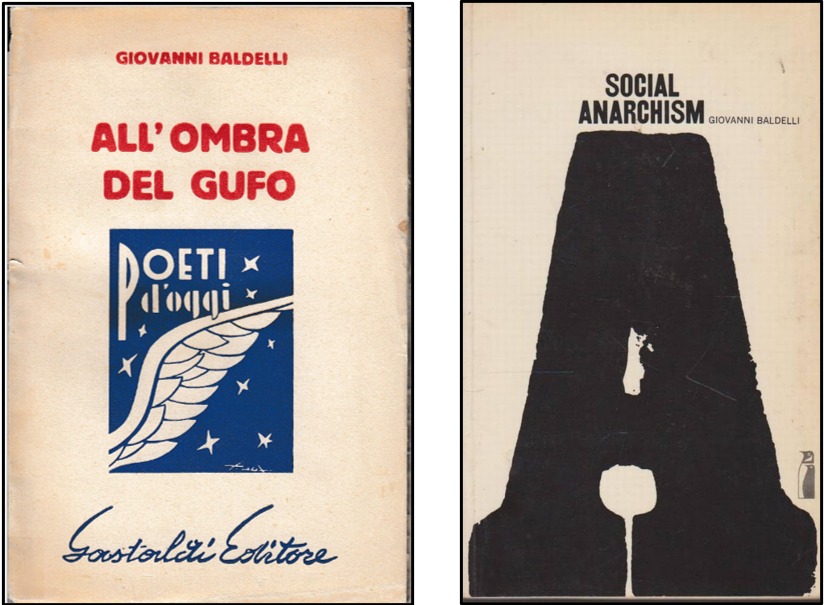
Additionally, he authored several literary works including collections of poems in Italian, French and English. Some the poems he wrote during internment are included in All’Ombra del Gufo.
But his crowning work was his Social Anarchism which defined social anarchism and provided a framework for its introduction. This treatise remains a major contributor to anarchist literature. Baldelli believed in an anarchist society based on ethical values: without laws, without political authority, without concentrations of power.
In 1963, Henry de Madaillan wrote of Baldelli in the preface for Chair à Étoiles: Baldelli, French poet. Certainly. And, sometimes, a great poet. A mocking and painful poet, comical and melancholic, dreamy and realistic, barbaric and refined, a virtuoso, from subtle irony to black humor, constantly contrasting, unexpected, surprising, ranging from the most transparent tenderness to the darkest brutality, fierce and abandoned, bloody and easy, prophetic and helpless, a poet without end and without limits, who speaks an original language, made for him alone, in which he does not hesitate to create the neologisms necessary for his expression in a style that is abrupt, complex and simple, heavy and light, perpetually back on the loom, of sovereign clumsiness and skill. Giovanni Baldelli, idealistic and willful, a perpetual contradiction within the unity of his innermost being, this Italian who teaches Spanish and Russian to the English, this French poet.[10]
A teacher, a writer, a poet, an anti-fascist and anarchist theorist, Giovanni Baldelli died in 1986.
His works:
Poetry
1953 All’Ombra del Gufo
1956 Seven Fugues
1963 Proses et Poèmes
1963 Chair à Étoiles
1965 Quand L’Aube Se Survit
1969 Le Pied à L’Etrier
1973 Itinerario
Philosophy and Politics
1971 and republished 2009 Social Anarchism
Plays
1955 The Comedy of Death (a seriously psychological study on death)
1963 Triangle in Red (cruelties of communism)
Text by Joanne Tapiolas
References:
[1] Baldelli Giovanni, 1941-1942, NAA:A367 C76010, National Archives of Australia, Canberra.
[2] Alfio Bernabei, “A Song about the Arandora Star”, in Italian Scottish Identities and Connections 15, eds. Margaret Rose & Emanuela Rossini, (Italian Cultural Institute, 2000), 62.
[3] Alfio Bernabei, Italian Scottish Identities and Connections 15, 62.
[4] “Obituary Giovanni Baldelli,” Freedom News, Volume 47, Number 10 (November – December 1986): 19, https://freedomnews.org.uk/wp-content/uploads/2020/04/Freedom-1986_10.pdf
[5] Alfio Bernabei, Italian Scottish Identities and Connections 5, 63.
[6] Alfio Bernabei, Italian Scottish Identities and Connections 15, 67.
[7] Giorgio Enrico Scola, 12,000 miles behind barbed wire, ed. Julian Scola (2024), 27.
[8] Gioventù Numero di Natale No. 14 (December 1940).
[9] Dino Accini, 1943-1945, NAA:A367, C74676, National Archives of Australia, Canberra.
[10] Giovanni Baldelli, Chair à Étoiles (Ateliers de la Licore, 1963), 13.